Business Finland
What kinds of AI projects does Business Finland actually fund?
Four fundable AI shapes: applied research, novel productization, platformization, internationalization. Real approvals EUR 70k–957k (2021–2026). The filter: genuine technical or market uncertainty, not tools or integrations.
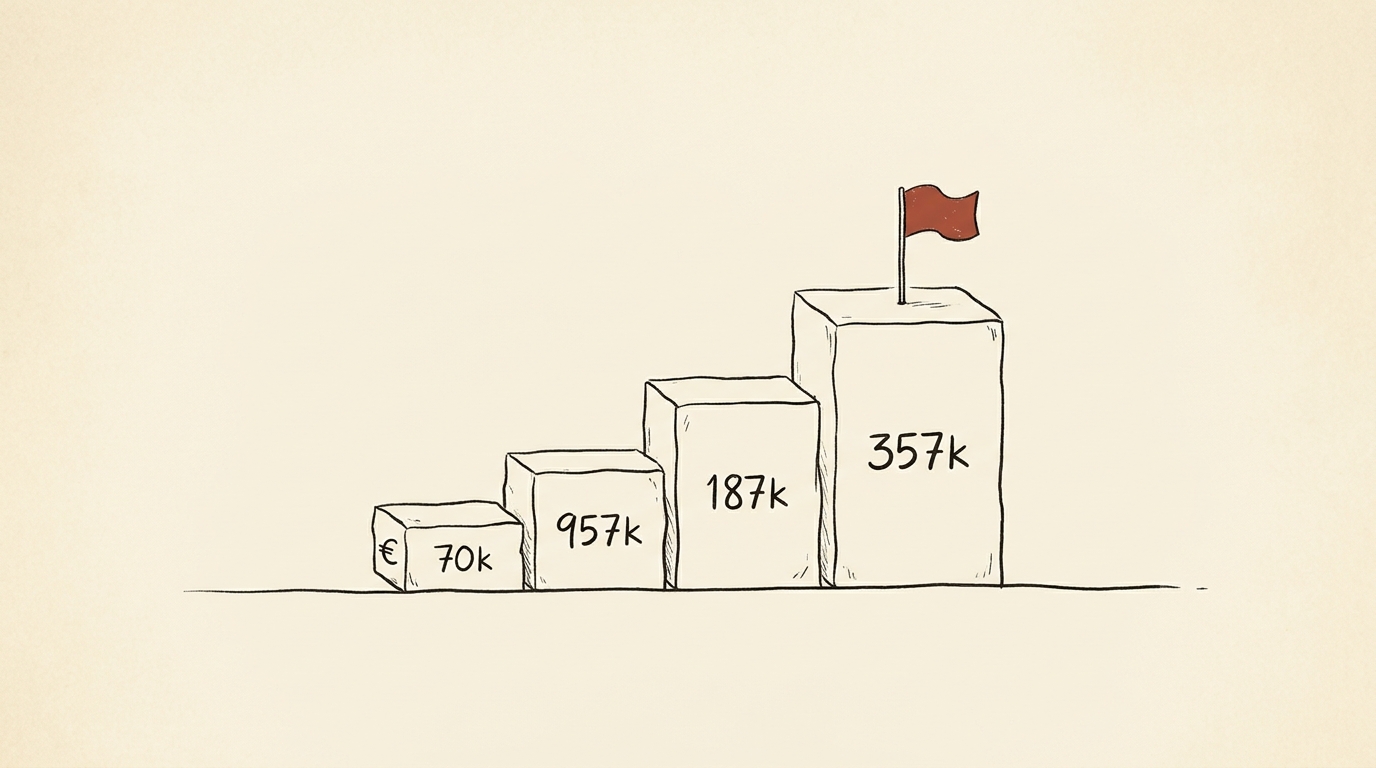
Short answer: Business Finland funds AI projects that carry genuine technical or market uncertainty — not tools, not off-the-shelf integrations. In practice, that means a narrow set of shapes: applied research, novel model or system development, ambitious productization of AI into a new offering, and internationalization of an AI-native product. Across four approved grants for Finnish companies (EUR 1.57M total, ranging from EUR 70k in 2021 to EUR 957k in 2024), the pattern is consistent — the funded projects were the ones that could honestly say “we don’t yet know how to build this, and finding out is the point.”
Business Finland’s own eligibility pages describe what they fund at a level that is technically accurate and practically useless — words like “research,” “development,” “innovation,” “growth.” Founders read those pages and still don’t know whether their specific AI idea is fundable.
The honest version is narrower. Business Finland is a public R&D funder, so their entire mandate is to de-risk work that is too uncertain for the private market to fund alone. If a project has no research uncertainty — you’re just building it, or buying it, or integrating an API — it does not qualify, no matter how strategic it feels internally. This is the filter that decides every application.
Below is the shape of AI work that has actually cleared that filter, drawn from four applications we have shaped for Finnish companies between 2021 and 2026.
What Business Finland actually funds for AI
There are four recurring project shapes in the AI R&D applications that get approved. Every real approval maps to at least one of these. Most map to two.
1. Applied research with a defined technical unknown. The company has a specific hypothesis — a novel model architecture, a data-scarce learning setup, an unproven combination of techniques for a hard domain problem — and needs a work package to test whether it’s viable. The uncertainty is technical, and the deliverable of the R&D is a validated (or invalidated) approach, not a product.
2. Novel productization of AI capability. The underlying model or technique exists in the literature, but no one has yet productized it inside your domain in a way that survives contact with real customers. The R&D uncertainty here is productization: data pipelines, integration, evaluation, reliability, safety — the unglamorous engineering that separates a Hugging Face demo from something a paying customer will run in production.
3. Ambitious platformization of an internal AI capability. A company already has an AI capability working internally for a narrow use case and now wants to turn it into a horizontal platform, a new product line, or a new go-to-market motion. The R&D piece is generalization: making a system built for one context robust across many.
4. Internationalization of an AI-native product. Business Finland’s growth and internationalization funding covers the cost of turning a Finnish AI product into a competitive export. The “R&D” here is often less about model work and more about localization, regulatory adaptation, integration with foreign systems, and go-to-market experimentation.
Most funded AI applications live at the intersection of two of these — for example, a novel productization (2) that also platformizes an internal capability (3), or an applied-research bet (1) that leads directly to internationalization (4).
The four categories, mapped to real project sizes
The euro figures below come from four Business Finland approvals we shaped between 2021 and 2026. Client identities are protected; what matters is the shape, and the shape is what predicts sizing.
| Year | Approval | Project shape | Category |
|---|---|---|---|
| 2021 | EUR 70k | Early feasibility study for an AI-augmented product idea at a small Finnish company. Single work package, tight scope, one uncertainty to test. | Applied research (1) |
| 2024 | EUR 957k | Multi-year applied-AI R&D programme for a mid-market industrial company — computer-vision and ML system built from data no one else has, with productization and scale work packages. | Applied research (1) + Novel productization (2) |
| 2025 | EUR 187k | Focused AI feature build for a SaaS scale-up — LLM-augmented internal-operations layer, one clean uncertainty and a clear productization arc. | Novel productization (2) |
| 2026 | EUR 357k | Platformization of an internal AI capability into a new product line, with a first internationalization work package attached. | Platformization (3) + Internationalization (4) |
Three signals from that table are worth naming explicitly.
Project size follows project shape, not company size. The EUR 957k grant went to a company that could credibly execute a multi-work-package research programme over two years. The EUR 187k grant went to a company that had one honest uncertainty to test in six months. Both got what the project justified. Neither company would have gotten the other’s number.
The 2021 EUR 70k is not the ceiling for a starter application. It was that size because the work honestly was that size. Business Finland does not reward padding.
Multi-category projects can shape larger budgets. The 2024 (research + productization) and 2026 (platformization + internationalization) grants sit at the top of the range partly because they honestly stitched two funded shapes into one coherent programme.
What Business Finland does not fund for AI
The failures we see, over and over, come from misunderstanding the uncertainty test.
-
AI tool procurement. Buying seats of a commercial LLM API, or a vertical AI SaaS, or a vendor-built copilot — not fundable. There’s no research uncertainty; the vendor already solved it.
-
Integration-only work. Wiring existing AI services into an existing product, without generating new technical or market knowledge, is a build, not R&D.
-
AI “strategy” or roadmapping. Consulting deliverables that produce a plan are not R&D outputs. Business Finland funds work; it does not fund thinking-about-work.
-
Pure content or marketing AI use. Using AI to generate marketing assets or automate content ops is business-as-usual productivity, not R&D uncertainty.
-
Deployments where the risk is entirely commercial. If the technology is settled and the only open question is “will customers buy it,” that’s a market question, not R&D — and it belongs to sales funding, not R&D funding.
The recurring failure mode is a founder describing an ambitious deployment of a well-understood technique and expecting the ambition alone to qualify as R&D. It does not. The word that matters is uncertainty — technical, methodological, or productization uncertainty that Business Finland’s own evaluators can name back to you.
How the project shape decides the size
Once a project honestly fits one of the four fundable shapes, three levers move the euro figure:
-
Number of clean work packages. Each work package is a bounded piece of R&D with its own deliverable and its own uncertainty. One WP = starter-size (EUR 50–150k typical). Three to five WPs = mid-size (EUR 200–500k). Five-plus with two-year horizon = programme-size (EUR 700k–1M+).
-
Team cost density. Business Finland funds a share of eligible costs — mostly senior R&D personnel and a bounded slice of subcontracting. Higher salary density and more senior hours per WP raises the budget honestly.
-
Company profile fit for the specific instrument. Sprint, R&D grant, Young Innovative Company, Tempo, growth/internationalization — each instrument has its own ceiling, cost split, and eligibility test. The right instrument for a given project shape is often the single biggest lever on final approved amount. (See the Sprint-vs-grant piece linked below.)
The honest sequence is shape → work packages → instrument → budget. Any founder who starts by picking a target budget and works backward will either get rejected or shrink the application into something the evaluators can accept — usually much smaller than it could have been.
FAQ
Does Business Finland fund AI startups with no revenue? Yes, when the project has real R&D uncertainty and the company can co-fund its share of eligible costs. The company’s revenue is less decisive than the project’s technical honesty and the team’s ability to execute.
What’s the smallest AI R&D grant worth applying for? Below roughly EUR 50k of Business Finland contribution, the application effort rarely pays back. The 2021 EUR 70k grant we shaped was worth it because the work honestly matched that scope and unlocked follow-on funding later.
Does using an off-the-shelf LLM disqualify a project? No — but the R&D uncertainty has to sit somewhere else. Fine-tuning strategy on scarce domain data, novel evaluation methodology, retrieval architectures for a hard domain, safety and reliability work — all fundable. “We will call GPT-4 in a nice UI” is not.
Can a foreign-founded company registered in Finland get AI R&D funding? Yes, provided the Finnish entity is a real operating company with substance in Finland. This is covered in depth in the foreign-founded eligibility piece below.
How do you know in advance whether an AI project is fundable? Two tests, honestly answered. First: can you name the specific technical, methodological, or productization uncertainty in one sentence? Second: would a competent evaluator agree the private market would not fund this project alone? If both answers are yes, it is a candidate.
How much of the total budget does Business Finland actually pay? For R&D grants, typically 50–65% of eligible costs depending on company size and the instrument. The rest is company co-funding, which can be cash or loan. Sprint sits lower and shorter; growth/internationalization instruments differ again.
The one-sentence version
Business Finland funds AI projects with a real R&D uncertainty at their core, in one of four shapes — applied research, novel productization, platformization, or internationalization — and the euro figure is a function of shape, work-package count, and instrument, not company ambition.
Related: Business Finland R&D grant vs R&D loan — which one, when, and why the mix matters · Are Business Finland grant consultants worth the fee? · Can a foreign-founded company registered in Finland get Business Finland funding?